

Underground Drone Cinematography at Danby Quarry | Flying 2,000 Feet Below Ground

Updated: 7 days ago

The History Behind Vermont’s Danby Marble Quarry

Some productions take you to beautiful places. Others take you somewhere few people on earth will ever experience. Recently, AIRWOLF had the opportunity to capture aerial footage nearly 2,000 feet underground inside the legendary Danby Marble Quarry for a Boot Barn Work campaign focused on the hardworking crews who keep the quarry operating deep beneath Vermont’s mountains. This type of underground drone cinematography requires an entirely different level of preparation compared to traditional outdoor aerial filming.
The Danby Quarry is not just another industrial location. It is the world’s largest underground marble quarry, filled with enormous chambers, winding tunnels, massive loaders, and marble walls that disappear into darkness.
The history of the quarry dates back to the 1800s, with underground mining operations beginning in the early 1900s. Over the decades, Danby marble has been used in iconic American landmarks including the Jefferson Memorial and portions of the U.S. Supreme Court building.
Driving into the quarry feels surreal. You descend through a tunnel carved directly into the mountain before emerging into an underground world where giant slabs of marble are still extracted every single day.
The scale underground is difficult to fully understand until you experience it in person. Massive equipment moves through cathedral-sized chambers while crews work beneath thousands of feet of solid rock overhead.
Projects like this are exactly why the Boot Barn Work article on the quarry resonated with so many people. It shines a light on an industry most people never get to see and the workers whose effort helps build America from the ground up.
Underground Drone Cinematography Without GPS
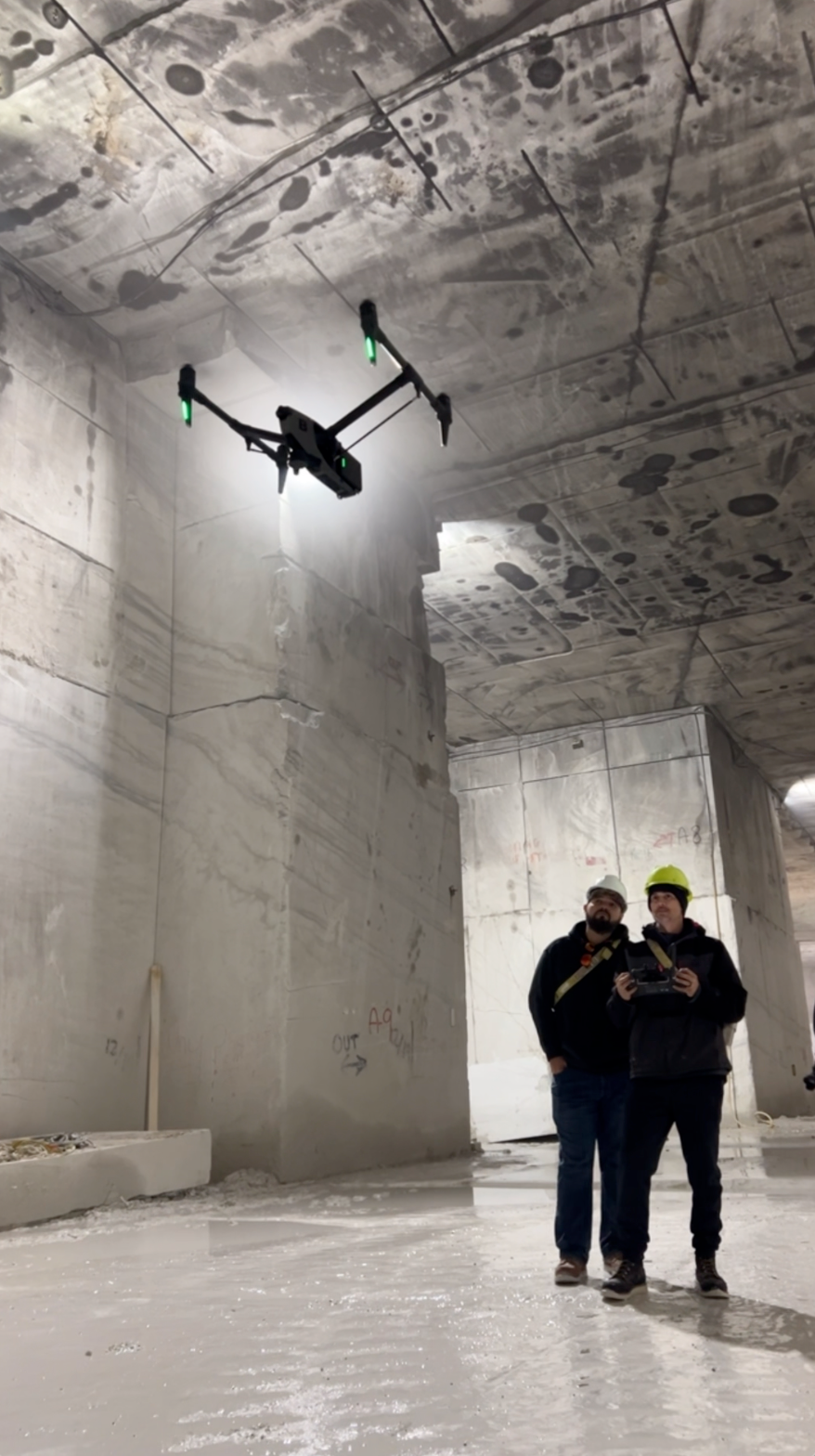
Flying a drone underground is completely different from flying outdoors.
Once you descend deep enough inside the quarry, GPS disappears entirely. There are no satellites, no positioning assistance, and no safety net. The aircraft must rely on onboard sensors, vision positioning systems, lighting conditions, and constant pilot input to maintain stable flight. Most drone pilots rely heavily on GPS stabilization without even realizing it. Underground, everything changes. Flying inside an active marble quarry introduces serious complications that most drone operators will never encounter.
Signal Interference
Rock, steel, heavy equipment, and the mountain itself can interfere with transmission signals. Maintaining a reliable connection becomes critical when flying deep inside underground chambers.
Low Light Conditions
Many sections of the quarry are extremely dark. Limited lighting can affect obstacle sensing systems and visual positioning performance, increasing the difficulty of stable flight.
Dust and Air Quality
Quarries are active industrial environments. Dust, moisture, and airborne debris can reduce visibility and impact equipment performance.
Confined Spaces
Unlike outdoor environments, underground operations involve tight access points, moving machinery, uneven terrain, cables, and very limited room for error.
Navigation Challenges
Underground tunnels can quickly become disorienting. Maintaining awareness of aircraft position while coordinating with ground crews is critical during every flight.
This is not the type of environment where you simply launch and improvise.
Every shot required planning, communication, and complete confidence in both the equipment and the crew.
The Equipment Behind the Flights

For this project, AIRWOLF used the DJI Inspire 3 as the primary aerial platform.
The Inspire 3 gave us the cinematic image quality and low-light performance needed to properly capture the scale and atmosphere of the underground marble quarry while still maintaining precise flight control in an extremely challenging environment.
Before production officially began, we conducted a dedicated scout day underground to evaluate how the aircraft would respond inside the quarry. During the scout, we intentionally flew the Inspire 3 without the X9 camera payload attached. This allowed us to safely test the aircraft’s behavior in a GPS-denied environment before introducing the full cinema package into the operation.
Successfully pulling off underground drone cinematography inside an active marble quarry required extensive planning, testing, and coordination between the flight crew and production team. The scout flights helped us evaluate signal reliability, aircraft stability, vision positioning performance, and overall flight confidence deep underground.
Once filming officially began, we mounted the full DJI X9 camera system and captured cinematic aerial shots throughout the quarry’s massive underground chambers. The Inspire 3 performed exceptionally well underground, especially considering the difficult lighting conditions and complete lack of satellite positioning.
The Crew Behind the Underground Experience

Projects like this only happen because of a strong crew willing to adapt to difficult environments and constantly changing conditions.
The Boot Barn Work production team brought together an incredible group of creatives and technicians who helped bring the story of the quarry to life. The project included Creative Director Alex Esparza, Producer Tyler Hampson, Cinematographer Max Aldrich, photographers Dana Pennington and Derrick Pham, stylist Madeline Hansen, BTS coverage by Danielle Bartley, audio by Jared Payzant and sculpture Sebastian Piazza. AIRWOLF handled aerial operations with Wolfgang Weber as pilot and Aerial DP Rob Watt.
One of the most impressive parts of the experience was watching the quarry workers themselves operate inside this environment every single day. Massive machinery moved through underground tunnels with incredible precision while normal quarry operations continued around an active film production.
The collaboration between the production crew and the quarry workers was essential. Underground environments leave very little room for mistakes, especially when coordinating heavy equipment, moving crews, limited lighting, and aerial operations all at the same time.
Everyone involved helped create something visually unique while maintaining a strong focus on safety and efficiency throughout the project.
SOME BEHIND THE SCENES
Taking in the scale of the quarry. Planning the next shot underground. The Inspire 3 ready for takeoff. One of the many tunnels connecting the enormous underground chambers inside Danby Marble Quarry. Exploring the marble processing area. Reviewing the day's coverage. Before heading underground. Documenting life beneath the mountain. Deep inside Danby Quarry. Getting a closer look. Capturing the moments between shots. Few people understand marble quite like sculptor Sebastian Piazza. Standing deep inside Danby Quarry Wolfgang Weber and Rob Watt inside Danby Marble Quarry nearly 2,000 feet underground
The Hard Work Behind the Marble Industry
One of the biggest takeaways from filming underground was gaining a deeper appreciation for the people who work there every day.
The crews inside Danby Quarry operate in one of the most demanding industrial environments imaginable. Safety, communication, and precision are critical at every stage of the operation.
Watching workers cut, move, and process enormous slabs of marble underground was incredible to witness firsthand.
There is a level of toughness and craftsmanship required for this type of work that deserves recognition. These are the people responsible for extracting materials that eventually become buildings, monuments, architecture, and infrastructure across the country. Capturing that story from the air added an entirely new perspective to the project.
Why Underground Drone Cinematography Matters
For AIRWOLF, projects like this are about more than cinematic visuals. They are about telling stories from places most people will never experience themselves.
Flying 2,000 feet underground inside a marble quarry pushes both technology and pilot skill to the limit, but it also creates imagery that feels impossible until you see it on screen.
The combination of industrial history, underground environments, skilled workers, and cinematic aerial movement made this one of the most unique drone operations we have ever been part of. And honestly, stepping into a mountain with an Inspire 3 and flying through a living, breathing underground quarry is something we will never forget.
CHECK OUT SOME OF OUR SHOTS
Final Thoughts From Beneath the Mountain
The Danby Marble Quarry represents a hidden side of American industry that deserves attention. Beneath Vermont’s mountains, crews continue a tradition that has been operating for more than a century while supplying marble used around the world.
Being trusted to document that environment from the air was an incredible experience for AIRWOLF Drones and a reminder of how powerful aerial cinematography can be when paired with real human stories.
From navigating GPS-denied environments to flying through enormous underground chambers, this project challenged every part of the filmmaking process in the best possible way.
Sometimes, the most cinematic places on earth are the ones hidden deep underground.
CHECK OUT THE FINAL VIDEO
Follow @airwolf_drones and @bootbarnwork for more behind-the-scenes content, exclusive footage, and future collaborations that continue to celebrate the real American grit behind the lens.
Support Our Work
If you enjoy the content we share and want to support what we do, you can browse gear we personally use and recommend here:Shop Drone + Camera Tools on Amazon Purchases made through this link help keep us flying — at no extra cost to you.
Listen to Getting Made
Want to hear more about what goes on behind the camera? Check out Getting Made, a filmmaking podcast exploring the people, stories, and experiences behind working in the film and television industry.
Work With Us
Whether you're producing a commercial, series, broadcast or branded shoot, we bring industry-level drone cinematography to every set.
Contact Us – Start a conversation about your next project
Drone Services – See what we offer
Aircraft We Fly – Meet the tools we bring to set
Our Work – Explore past projects
Flight Log Blog – More behind-the-scenes stories and gear insights

Comments